- Stellar increased its share of tokenized non-US government debt from 0.7% to 42% within twelve months, according to Allium’s latest figures.
- The network now holds $319 million in tokenized government debt, representing the largest allocation among competing blockchain networks.
- Total tokenized non-US government debt reached $766 million in September 2026, despite declining from its earlier peak.
Stellar tokenized debt adoption has accelerated sharply, giving the blockchain a leading position in government-backed digital assets.
Stellar Secures 42% of Tokenized Government Debt
ALLINCRYPTO reported that Stellar’s share of tokenized non-US government debt increased substantially. According to the data from Allium, the growth rate ranged from 0.7% to 42% after 12 months. The network has about $319 million in these tokenized financial instruments.
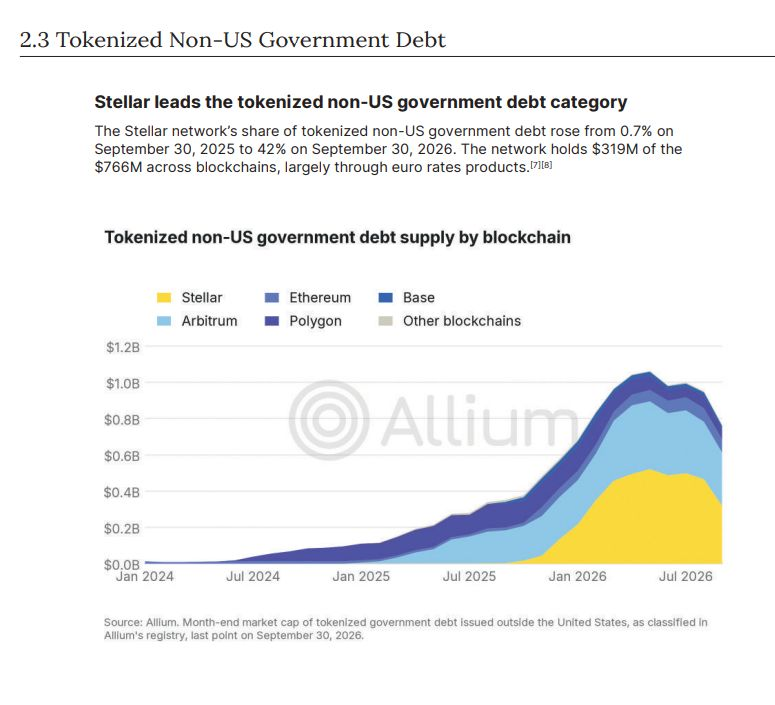
As of September 30th, 2026, Stellar is ahead of the other blockchain networks. It owns 42% of the market’s total value, which is $766 million. This marks a considerable change from its limited presence one year earlier.
Expansion reflects shifts in distribution across the tokenized government debt segment. Until now, stellar’s share of the market was limited. But its allocation rose significantly during the next 12 months.
The numbers make it clear that there is nothing bigger than Stellar in this area. Other tokens holding market positions include Ethereum, Base, Arbitrum, and Polygon. However, their presence together does not seem to have curtailed Stellar’s growth.
Tokenized Debt Growth Reshapes Stellar’s Market Position
The historical chart provides further context for Stellar’s growing market share. During 2024, the network maintained a relatively small allocation. Ethereum and other competing platforms accounted for larger portions of outstanding assets.
That distribution began changing during the opening months of 2025. Stellar’s allocation expanded more visibly towards the year’s final quarter. Its market share subsequently increased as additional debt products entered the network.
The strongest expansion occurred during the first half of 2026. Stellar’s holdings approached approximately $500 million around the middle of that year. This represented a substantial increase compared with its earlier allocation.
However, the subsequent figures show a contraction towards September. Its holdings declined to approximately $319 million during this period. Despite that reduction, Stellar retained its leading market position.
The wider market experienced similar movements during the same period. Total tokenized non-US government debt approached $1.1 billion before declining. By September, the combined market had fallen towards $766 million.
Institutional Adoption Strengthens Stellar’s Competitive Standing
The increasing allocation puts Stellar in a top tier position in the blockchain infrastructure space. Traditional financial instruments can coexist in the blockchain systems with the help of tokenization. These products can be issued, held and transferred via digital infrastructure.
The development of a financial application is clearly illustrated in the government debt. Its presence across several networks demonstrates growing competition between blockchain platforms. Stellar is currently allocated, so it has a foot in the door in this market.
The figures provide hard data of the breadth of institutional engagement in the broader ecosystem. Its value of $319 million is indicative of the value of its assets. This will also make it easier to see the financial system of Stellar.
But the growth of the tokens does not necessarily equal the demand for XLM. Stellar does not reflect the value of the government debt. There is a difference between network adoption and direct token trading.
Maintaining the current market share will necessitate ongoing market share. It could affect the direction of the development of Stellar if more issuers joined and more funds dedicated to the project. There are other networks in the same business arena as well.
If the market continues to participate, the current lead will be maintained. Other issuers and continued allocations may impact the situation for Stellar. Other competitive networks are still operational in the same financial sector.