
- 30,000 ETH moved from Coinbase Prime into three fresh wallets, creating a custody signal without confirming immediate selling pressure.
- Ethereum derivatives remain active, while earlier liquidation spikes show how quickly leveraged positions can unwind during sharp price moves.
- Open interest and futures activity remain elevated, making wallet flows and liquidation data important signals for Ethereum’s next market move.
Ethereum whale activity has intensified as 30,000 ETH leaves Coinbase Prime, while derivatives data reveals persistent leverage and elevated market participation.
Whale Transfers Put Exchange Flows Under Focus
According to Onchain Lens, a whale has withdrawn 30,000 ETH from Coinbase Prime. Around $57.21 million was the value of the transfer. Data referenced in the report came from Nansen.
The funds were divided equally among three newly created wallets. Each destination received approximately 10,000 ETH during the reported transactions. The displayed values stood near $19.06 million per transfer.
The receiving addresses were 0x53242, 0x7A71F1, and 0x401879. The three transfers came from Coinbase Prime’s hot wallet. The structure indicates a deliberate division of the reported position.
However, the transaction records do not establish the whale’s final objective. The ETH moved into external wallets rather than another exchange account. Therefore, immediate selling pressure cannot be confirmed from these transfers alone.
Derivatives Data Shows Persistent Leverage
The derivatives chart shows Ethereum experiencing several major liquidation events. The largest spikes appeared around late May and early June. The movements took place during a dramatic dip in the price of Ethereum.
ETH fell from roughly $2,000 toward the $1,500-$1,600 region. In parallel, liquidation activity ramped up across all perpetual markets. This shows a wide reset in leveraged positions.
Ethereum’s price then rallied back up to the $1,900-$2,000 level. Liquidation levels subsequently became less extreme across the measured period. Still, recurring spikes show leverage remains active throughout the market.
The chart also shows approximately $6.68 billion in open interest. Gate follows with $2.62 billion, while CME records approximately $2.58 billion. These figures indicate substantial derivatives exposure remains outstanding.
Futures Activity Keeps Market Risk Elevated
Ethereum futures volume remains considerable across major trading venues. The leading exchange records approximately $5.71 billion in volume. OKX follows with about $3.76 billion, while MEXC reaches roughly $2.28 billion.
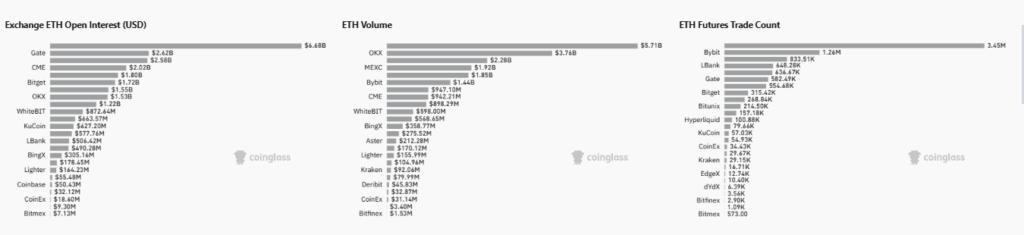
Trade activity is similarly elevated across the monitored exchanges. The leading venue records approximately 3.45 million futures trades. Bybit follows with roughly 1.26 million transactions.
This activity shows that derivatives remain central to Ethereum’s market structure. However, high volume alone does not establish a directional market bias. Price movement, open interest, and liquidation activity provide stronger combined signals.
The whale transfer adds another variable for traders monitoring available exchange liquidity. If the three wallets retain their ETH, the move may represent custody management. If those balances later reach exchanges, the market interpretation could change materially.
For now, the evidence points to substantial whale movement alongside active derivatives positioning. The three-wallet allocation provides clear addresses for continued on-chain monitoring. Future transfers, staking activity, or exchange deposits could reveal the whale’s next move.
The broader derivatives picture remains equally important for Ethereum price analysis. Rising leverage could amplify future moves in either direction. Conversely, controlled positioning could reduce the likelihood of another broad liquidation event.
The strongest confirmation will come from how wallet flows interact with derivatives positioning. Large exchange deposits could increase concerns about potential distribution. Continued withdrawals alongside stable leverage could instead reinforce the custody-focused interpretation.