

- Binance outflows from UNI’s 10 largest transactions reached a five-year high as the token approached $3.
- UNI’s annualized burn rose to about $90 million after the Robinhood-linked fee switch began on July 27.
- UNI remains bearish below $3.40, with $3.25-$3.20 providing support as momentum indicators show early improvement.
Uniswap (UNI) fell from above $4.40 in late July to about $3.25, while whale accumulation reached a five-year high. Analyst Darkfost said Binance outflows from the largest transactions hit records near $3, while Standard Chartered’s Geoffrey Kendrick raised his 2030 UNI target view. UNI’s short-term chart remains bearish despite improving momentum.
UNI Outflows Reached a Five-Year Record
According to Darkfost, UNI accumulation on Binance has reached its strongest level in five years during this dip. He tracks accumulation through daily outflows from Binance’s 10 largest transactions.
Notably, those outflows reached record levels when UNI approached $3. The token peaked above $43 in 2021, leaving it down more than 93% from that high. The 10 largest daily transactions averaged 7,300 UNI leaving Binance, a five-year record. However, the same group still accumulates 5,600 UNI daily.
Kendrick Points to Higher UNI Burn
Meanwhile, Standard Chartered analyst Geoffrey Kendrick said his $100 UNI target for 2030 may be too low. He said the Uniswap-Robinhood partnership is performing better than expected.
The Robinhood-linked fee switch started on July 27, after which UNI burn roughly doubled. Kendrick put the annualized burn near $90 million, equal to about 25 million UNI. That figure represents slightly more than 4% of circulating supply at the current UNI price.
Kendrick said a 4% burn rate is unsustainable. At his $6.50 year-end 2026 target, Kendrick estimates annualized burn at 2.2%. He also noted that additional partnerships could affect the rate.
UNI Holds Near $3.25 as Momentum Improves
UNI trades at $3.2783, down 0.45%, after opening at $3.2943. The candle reached $3.2943 and fell to $3.2616. UNI broke below $3.60 and $3.40 around August 12–14, with large volume spikes during both declines.
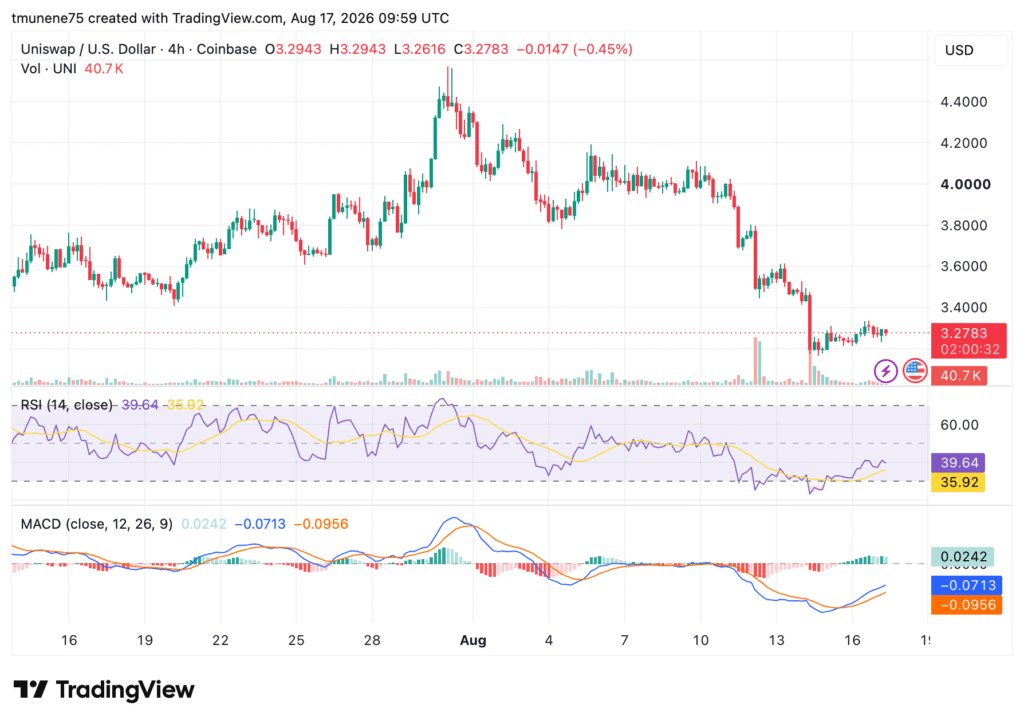
Price later stabilized around $3.25–$3.30. RSI is at 39.64 against an average of 35.92. It remains below 50, while its recovery shows easing selling pressure. The MACD line is -0.0713 versus -0.0956 for its signal line.
The 0.0242 histogram is positive, but both lines remain below zero. Support is at $3.25–$3.20, while resistance is at $3.40, $3.55–$3.60, and $3.80. A break below $3.25 could renew selling.