

- U.S. households now hold about 46% of financial assets in equities, increasing concentration risk if stocks disappoint.
- Long-term S&P 500 earnings growth expectations have climbed above 25%, leaving less room for weaker-than-expected results.
- Crypto valuations and leverage reset during the bear market, creating a different setup that may diversify concentrated equity exposure.
U.S. equities face a narrower margin for disappointment as earnings expectations rise, according to Grayscale research. The firm said U.S. households now hold about 46% of their financial assets in corporate equities. Zach Pandl, Grayscale’s head of research, said crypto has a different setup after a prolonged bear market reset valuations, leverage, and positioning.
Equity Exposure Reaches A Record Share
Pandl said household portfolios have become more concentrated in stocks than at any point in history. Corporate equities now account for roughly 46% of household financial assets, according to the research.
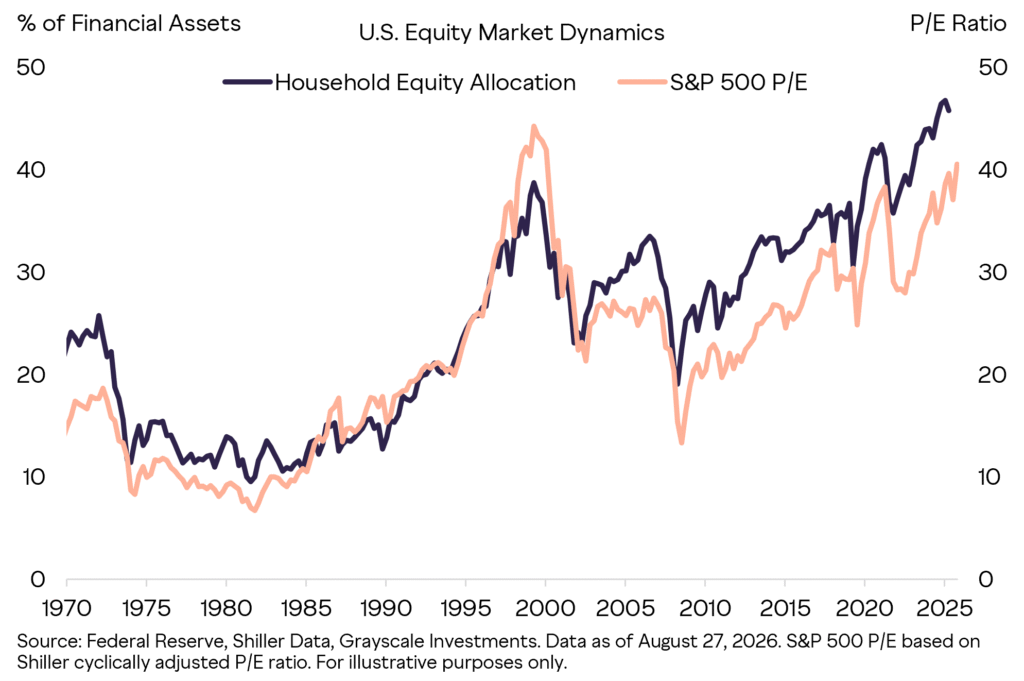
That level of exposure comes alongside historically high price-to-earnings ratios across U.S. equities. However, the research also points to higher expectations for future S&P 500 earnings growth. Consensus long-term earnings growth estimates have historically ranged between 10% and 15%. Recently, those estimates have climbed above 25%, according to Grayscale.
Higher Earnings Expectations Raise The Stakes
Grayscale said strong artificial intelligence investment could support current equity valuations. However, higher earnings expectations leave less room for results to fall below forecasts. The research describes this as a narrower margin for disappointment in the U.S. stock market.
That shift matters because investors already hold a large share of their financial assets in equities. Meanwhile, crypto has moved through a different market cycle following an extended bear market. The downturn reset valuations, leverage, and investor positioning across digital assets, according to Pandl.
Crypto Enters A Different Market Setup
Pandl said digital assets may offer exposure to an emerging cycle with improving fundamentals. He also described crypto valuations as comparatively depressed after the bear-market reset.
The research contrasts that starting point with U.S. stocks, where prices require strong growth or wider margins. For equities, Grayscale said unusually strong top-line growth or margin expansion may support elevated prices.
Crypto instead offers separate exposure without requiring investors to replace stocks within household portfolios. Pandl framed the approach around diversification away from concentrated equity exposure. He said the focus remains on adding a different asset class rather than replacing equities.