
- Ethereum holds $4,500 support as ETF inflows and treasury strategies boost long-term market demand.
- Analysts track ETH between $4,000–$5,000, with $4,500 as the critical level for the next price move.
- Ethereum ETFs attract $1.1B in five days, signaling renewed institutional confidence in the asset.
Ethereum was trading at around 4,520 after it hit the 4,500 mark during a decline on the weekend. Analysts emphasized that possession of this area is crucial to the overall market trend. Investors also monitored how the institutional flows into exchange-traded funds and treasury strategies would affect ETF performance in the next few weeks.
Analysts Watch $4,000 to $5,000 Range
Market analysts remain focused on the $4,000 to $4,100 range as a critical support area. Crypto trader Daan said ETH had completed the hard part by breaking above $4,100 and turning it into support. He added that the final step is to move above its former all-time high near $4,956 for price expansion. According to him, wicks below $4,000 are acceptable, but repeated closes under this zone would weaken the bullish outlook.
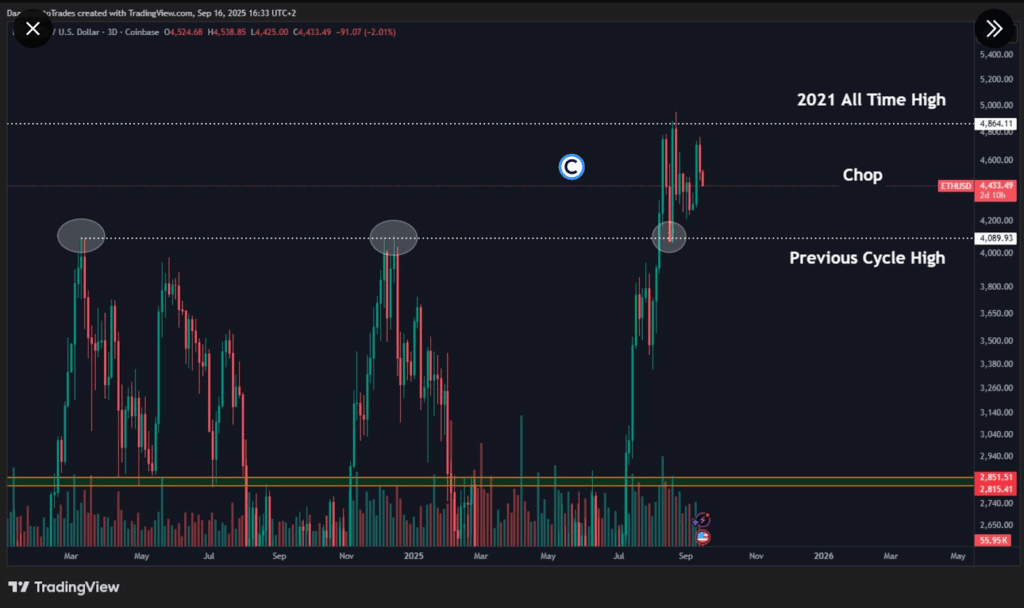
Consolidation is also indicated by technical indicators. ETH is trading close to the 50-day simple moving average with the resistance at $4,800-5000. The relative strength index is near the neutral levels every day meaning that there is not much momentum in either direction. Before a more effective move builds up, analysts are watching whether ETH can hold over $4,500.
Ted, another market watcher, noted that ETH failed to reclaim the $4,700 level and is now moving lower. He explained that if $4,500 holds, ETH could return to the $4,700 to $4,800 area. A break below $4,500, however, may push ETH back toward the $4,000 to $4,200 zone.
Treasury Holdings and Institutional Demand
Standard Chartered released research on digital asset treasuries, stating that Ethereum-focused companies may be more sustainable than Bitcoin or Solana-based treasuries. The report explained that Ethereum treasuries can generate yield from staking, which improves their ability to maintain a positive market-to-net asset value ratio. This ratio compares a company’s market cap with the value of its crypto holdings.

The bank’s global head of digital asset research, Geoffrey Kendrick, said that Ethereum treasuries have a higher probability of long-term success. He added that Bitcoin treasuries are facing saturation, while Solana treasuries are more exposed to new Nasdaq funding rules. BitMine Immersion, which holds the largest Ethereum treasury, has also announced plans to purchase 5% of ETH’s circulating supply.
Treasury strategies have contributed to Ethereum’s demand in addition to exchange-traded funds. In the past year, both ETFs and treasuries influenced price action and provided liquidity to the market. The ability of treasuries to raise funds cheaply and sustain positive ratios remains important for further Ethereum accumulation.
ETF Inflows Support Price Stability
Ethereum ETFs recorded $360 million in net inflows on September 15, the second-highest daily inflow in recent weeks. Over a five-day stretch, U.S.-listed Ethereum ETFs attracted $1.1 billion, led by BlackRock’s ETHA product. This followed earlier drawdowns in August, suggesting renewed institutional interest.
At the same time, trading volume has decreased, showing lower short-term activity. Despite this, ETH is still up over 3% week-on-week and nearly 8% from its September low near $4,180. The market regards $4,500 as the red line and prolonged trading above this mark will perhaps open into $4,800 to $5,000.
On-chain data also indicate that bigger wallets are accruing ETH with staking contracts being on the increase. This helps in the fact that long term investors are becoming more exposed as price consolidates. These two factors of institutional inflows and treasury strategies combined are still affecting Ethereum in and around its major levels of support.