
- Bitcoin’s $877,323 forecast and XRP’s $195.56 target would require substantial capital inflows and market valuations supported by lasting demand.
- Dogecoin, Shiba Inu, PEPE, and SUI have high projections, but token supply may make their way up to those rates difficult.
- Cryptocurrency forecasts can mislead investors when market capitalization, token unlocks, network activity, and actual demand receive little attention.
2028 crypto targets, whose prediction chart featured thirteen tokens at higher valuation levels than those shown, are being discussed. The numbers prompt questions about supply, capitalization, and demand to sustain such lofty projections.
Bitcoin and XRP Carry the Biggest Expectations
Nuvycrypto1998’s commentary questions whether the chart’s forecasts can stand against basic market calculations. The post names Bitcoin, XRP, SUI, Dogecoin, Shiba Inu, and PEPE among its featured assets. It also urges investors to examine fundamentals before accepting future price estimates.
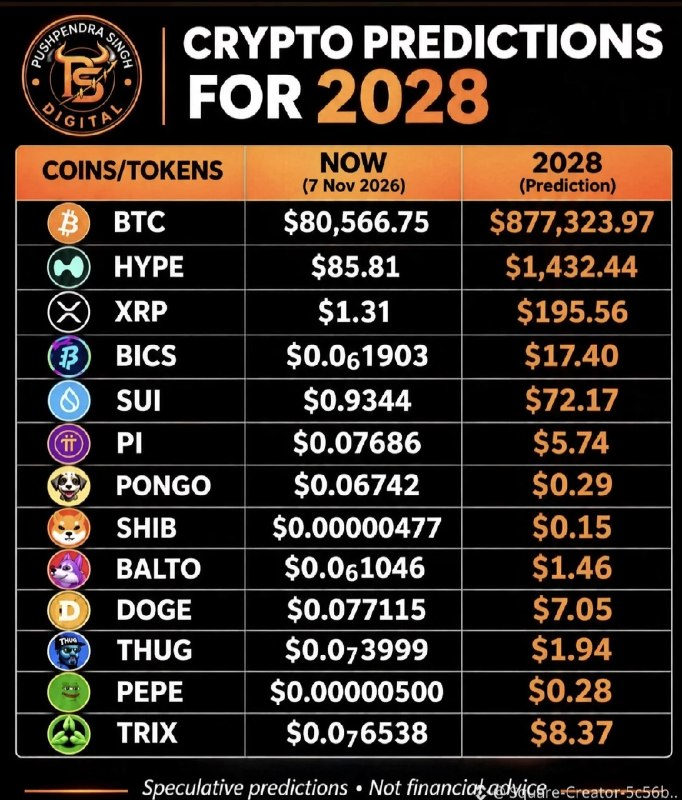
Bitcoin’s listed price is $80,566.75, while the chart assigns it $877,323.97 for 2028. That gap would require a dramatic expansion in BTC’s market value. Scarcity alone cannot carry the price without buyers willing to absorb the available supply.
XRP appears at $1.31, with a projected value of $195.56. That would put it in a much higher market cap bracket. Demand may be impacted by payment adoption, institutional liquidity and regulation, but not guaranteed.
Hyperliquid’s HYPE is shown at $85.81, with a target of $1,432.44. They are estimated to be priced between $0.29 and $17.40. Token distribution and competition would also matter as the market weighs that valuation.
Altcoin Forecasts Put Token Supply in Focus
SUI’s chart price is $0.9344, against a 2028 target of $72.17. Pi is listed at $0.07686, with a projected value of $5.74. Both estimates depend on demand rising enough to support much larger valuations.
Dogecoin carries a target of $7.05, compared with its displayed $0.077115. Shiba Inu’s forecast reaches $0.15 from $0.00000477. PEPE is assigned $0.28, despite a listed price of $0.00000500.
Those meme coin estimates lean heavily on the return of speculative buying. A popular name can draw traders, but attention often shifts quickly across the market. Circulating supply could make these targets harder to reach than their price tags suggest.
The chart also lists BICS, PONGO, BALTO, THUG, and TRIX. Their projected prices range from $0.29 to $17.40. Without supply and market-cap figures, those numbers alone reveal little about their required valuations.
Market Capitalization Separates Price Hype From Reality
A token’s quoted price tells only part of its story. The value of the asset in the market depends on the circulating supply. If billions or trillions of coins move around a cheap coin can already be worth a lot of value.
Token unlock schedules must be taken into account when examining these forecasts. Newly available coins may increase selling pressure, particularly when demand remains thin. Maximum supply and distribution patterns can change the calculation behind a target.
Project activity also matters beyond the trading chart. Development progress, governance, interoperability, and practical utility can affect whether users remain. Competition may also draw activity away, even when a project’s technology continues improving.
The predictions are forecasts and not facts for the year 2028. Things may be significantly different by that time in terms of market conditions, liquidity, and investor appetite. Some tokens may surge in value while others might not get anywhere close to their designated targets.
When investors look at these numbers, they must determine what the market cap at that price would be. That exercise can reveal targets lying on assumptions that are thin. Better assessments of the forecasts can be made based on supply, adoption and sustained buying.