- Regulatory clarity, institutional access, and stablecoin growth are creating multiple pathways for XRP within America’s evolving financial system.
- Major exchange outflows suggest reduced readily available supply, although declining balances alone cannot confirm sustained bullish momentum.
- RLUSD, tokenization, and banking infrastructure connect the XRP Ledger with broader changes across regulated digital finance and payments.
XRP financial integration is gaining attention as regulatory clarity, institutional access, stablecoins, and exchange outflows reshape the asset’s market structure across America’s evolving digital finance sector.
Regulatory Shifts Open New Institutional Channels
X Finance Bull recently connected XRP with America’s emerging financial infrastructure. The post pointed to regulatory clarity following the SEC-Ripple enforcement dispute. It also referenced institutional products, stablecoins, banking infrastructure, and tokenized finance.
The regulatory argument centers on a changing environment for digital assets. The supplied material describes XRP as an example of a digital commodity. It also points toward broader support for regulated crypto products and custody.
Institutional access adds another layer to the changing market structure. Bitwise reportedly accumulated 194.9 million XRP, while Franklin held 159.7 million. Canary also provides direct Nasdaq exposure through its XRP investment product.
These developments create additional routes between traditional markets and digital assets. Investors can gain exposure through regulated structures without directly managing blockchain wallets. However, institutional holdings alone cannot establish sustained demand or future price performance.
Stablecoins Strengthen the Broader Blockchain Infrastructure
The chart also places RLUSD within the developing U.S. financial framework. The stablecoin operates natively on the XRP Ledger, according to supplied information. Its reserves can include Treasuries, reverse repos, and government money-market funds.
Scott Bessent has discussed substantial potential growth for regulated stablecoins. The supplied material links that growth with increased demand for Treasury bills. That relationship connects blockchain-based financial products with traditional government debt markets.
The broader framework also includes Ripple National Trust Bank’s preliminary conditional approval. That development places Ripple-related banking infrastructure closer to regulated financial services. It could create additional channels for custody, payments, and digital-asset operations.
XRP as of writing trades at around $1.52. Recent data shows the token recovering sharply from levels near $1.00. That recovery occurred alongside heightened attention toward institutional and regulatory developments.
Exchange Outflows Add a Separate Supply-Side Signal
The exchange-flow chart provides another important part of the market picture. Binance recorded roughly $6.85 million in outflows across the displayed data. Upbit and Coinbase followed with approximately $6.04 million and $4.66 million.
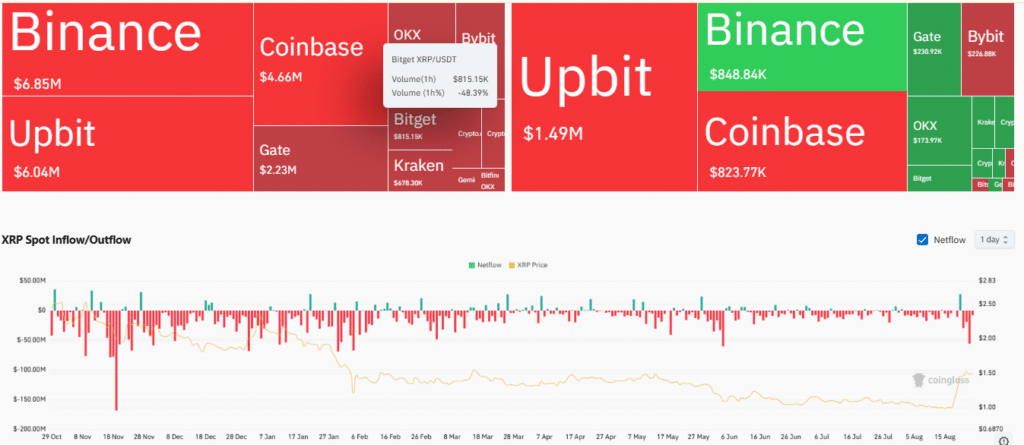
Meanwhile, reported inflows remained considerably smaller across major exchanges. Binance recorded approximately $848,840 entering, while Coinbase registered $823,770. The difference suggests more XRP moved away from exchanges than entered them.
However, exchange outflows should not automatically be treated as bullish confirmation. Tokens can leave exchanges for custody, transfers, or other purposes. Price appreciation therefore remains necessary to confirm stronger demand alongside declining exchange balances.
The combined picture remains focused on financial infrastructure rather than speculation alone. Regulation, institutional products, stablecoins, banking services, and tokenization form separate components. Exchange outflows then add a distinct supply-side element to the market structure.
These shifts collectively signal a larger institutional shift in place. The XRP Ledger already has infrastructure for payments, settlement, and tokenization. Future adoption will depend on measurable usage across those financial applications.