

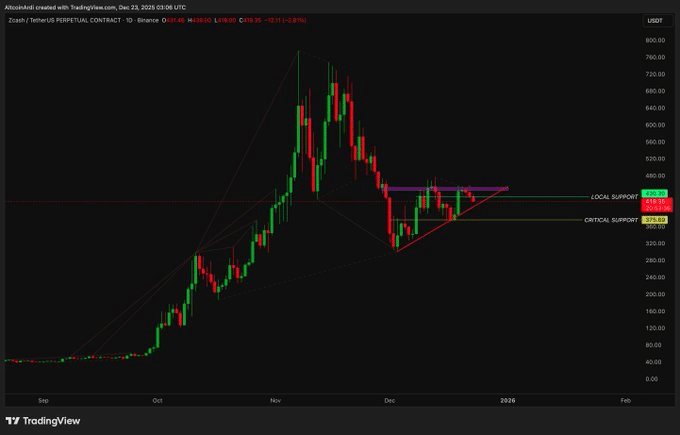
- ZEC slipped below $430, placing the current structure under immediate technical pressure.
- Loss of trendline support may confirm a Double Top toward the $375–390 zone.
- A recovery toward $450 preserves the ascending triangle and breakout probability
ZEC remains positioned at a decisive technical junction as recent price action weakens short-term structure. The market shows increasing seller control while traders await confirmation for directional continuation.
Structural Pressure Builds Near Trendline Support
ZEC recently lost the $430 support level, which previously held during consolidation. This breakdown places price directly on the lower boundary of its ascending triangle. That trendline has supported higher lows throughout the recent advance. It now represents the final technical defense for bullish positioning.
The ascending triangle formed after a strong impulsive rally earlier in the trend. Price compression occurred beneath resistance clustered near $450-$460. Such structures often resolve upward when demand remains persistent. However, acceptance below support increases the risk of bearish resolution.
A market update shared by analyst Ardi emphasized the importance of confirmation. The commentary noted no urgency to enter positions without validation. Price behavior around trendline support defines the near-term bias. Patience remains essential while volatility continues to contract.
Downside Scenario and Distribution Risk
If trendline support fails, ZEC may rotate toward the $375 to $390 support band. This zone aligns with prior consolidation and historical demand. It also represents the completion area for a developing Double Top structure. Such confirmation would signal a shift toward corrective price action.
In that environment, reactive selling often produces poor risk outcomes. Former support zones frequently convert into resistance during retracements. Waiting for a retest of broken levels improves trade clarity. This approach favors structure over emotional execution.
Broader market conditions add weight to this cautious stance. Slowing on-chain growth suggests reduced marginal demand across major assets. Such phases often result in extended consolidation rather than sharp reversals. Short-term volatility becomes the primary source of opportunity.
Short-Term Momentum and Tactical Focus
Over the last 24 hours, ZEC traded near $418 following sustained intraday selling. The chart printed consistent lower highs and lower lows. Early rejection near $447 confirmed strong overhead supply. Buy-side participation remained reactive rather than assertive.
Trading volume hovered near $586 million without downside acceleration. This behavior reflects controlled distribution instead of panic liquidation. Stabilization near $410 lacks confirmed basing characteristics. Further downside remains possible if demand fails to respond.
Short-duration trading strategies have gained relevance under these conditions. Incentive-driven trading formats reward precision and execution speed. ZEC’s volatility suits compressed trading windows effectively. Automation tools support discipline during fast-moving market phases.