

- Stablecoin supply grew over 50% in 2025, moving from speculative assets to practical tools for payments and commerce.
- USDT leads 60.75% of the market, while bank tokens may surpass stablecoins by 2030, enhancing traditional finance.
- Crypto innovations are reimagining finance, improving cross-border payments and access for frontier markets and digital firms.
Stablecoins are accelerating faster than many predicted, reshaping digital finance worldwide. Citibank forecasts total issuance could reach $2–4 trillion by 2030. This surge follows more than 50% growth in 2025 alone, fueled by increasing institutional adoption.
Besides large banks, digitally native companies are pushing stablecoins into commerce and real-world activities. Consequently, stablecoins are moving from speculative assets toward practical financial tools. Codex, a leading blockchain infrastructure, is providing the rails to facilitate this rapid expansion.
Issuance volumes jumped from roughly $200 billion at the start of 2025 to $280 billion today. Moreover, announcements of new crypto projects, record fundraising, and technical breakthroughs signal strong institutional interest. Back in April, Citi Institute GPS argued that 2025 would mark blockchain’s ChatGPT moment.
Now, that prediction is unfolding as stablecoins increasingly influence payments, investments, and cross-border commerce. However, the growth is not just about total supply; it reflects deeper integration of digital assets in everyday financial activities.
Market Dynamics and Institutional Adoption
In terms of market share as per DefiLIama, the USDT market has been led by Tether, accounting for some 60.75% of the market value at DeFi Llama’s valuation of $307.96 billion. The market has experienced steady growth since 2018 and then jumped to a sharp peak during the early months of 2022.
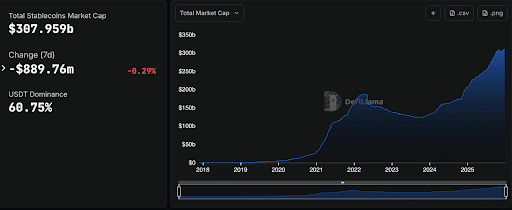
After the mid-2022 correction, the market capitalization gradually regained in the period of 2024 and 2025. Moreover, the trend of bank tokens, deposit tokens, and tokenized deposits works in tandem with the adoption of stablecoins.
A forecast by Citibank suggests that bank tokens are expected to surpass stablecoins by the year 2030, indicating that digital assets are an enhancement in traditional finance.
Digital assets are currently akin to “the early days of the dot-com era.” Some critics fear that banks will “be disintermediated.” However, when questioned, Citibank points out that some of the innovations from crypto markets are working to “reimagine the system, rather than tear it down.” The current system for payments within a domestic setting works well, enabling “real
Yet cross-border payments remain complex, and stablecoins offer unique advantages for international transactions and frontier market users seeking dollar access. Hence, both stablecoins and bank tokens are crucial for smarter, faster finance in the next decade.