
Key Insights
- Ripple released 1 billion XRP worth $2.19 billion, aligning with its regular monthly escrow schedule without disrupting market stability.
- XRP price showed strength post-unlock, rising more than 3% despite the volume injection, highlighting investor confidence.
- The price chart indicates a potential move toward $2.33, with Bollinger Bands supporting a 6.55% upside from current levels.
Ripple has released 1 billion XRP into circulation, valued at approximately $2.19 billion. This large-scale release came as part of the company’s scheduled monthly escrow unlock. The token distribution, conducted at the beginning of December, drew attention due to its volume and potential market impact.
Despite the substantial release, the XRP price demonstrated resilience. After a brief 1.45% dip following the unlock alert by Whale Alert, the token quickly rebounded. Within hours, XRP reached new local highs, posting a gain of more than 3% from the post-unlock low. The current market reaction suggests stable investor sentiment despite the inflow of fresh tokens.
Market Sees No Dumping Pressure from Release
Ripple’s escrow system is designed to manage token supply over time, with a portion of each release typically returning to locked reserves. Historical patterns show that roughly 600 million of the unlocked XRP often return to escrow. With over 34 billion XRP still in Ripple’s reserves, this monthly cycle continues to unfold with minimal disruption to the broader market.
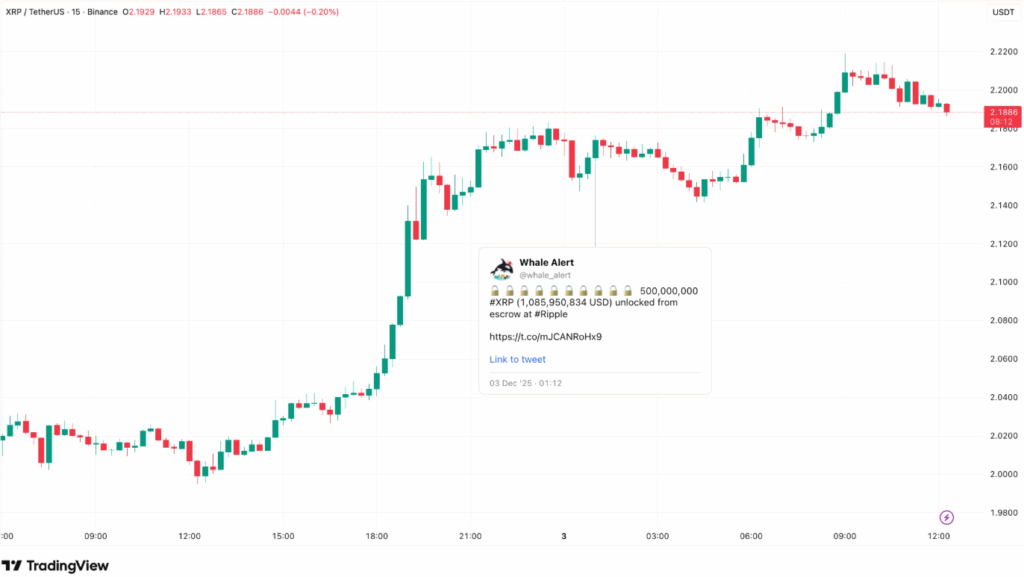
According to current technical analysis, XRP is on a direct path toward the $2.33 price zone. This level aligns with the upper curve of the Bollinger Bands on the daily chart. The projected target suggests a potential 6.55% upside from current levels. Analysts note that sustained momentum above recent gains could trigger further bullish movements.
Ripple Continues Controlled Supply Strategy
Ripple’s predictable approach to XRP distribution helps avoid unexpected market shocks. While the size of the monthly release often raises concerns, recent price behavior reflects market adaptation to the pattern. The company’s continued re-locking of a significant portion of each release supports price stability and long-term circulation control.