- TSC sits alone in the highest-risk tier, while XEL, KTA and RIO form the high-risk group in the 2026 token ranking.
- The middle tier is occupied by PONS, ANYONE, QTC, ARX and CNPY, the largest category on the published watchlist.
- ALGO, KAS, TAO and ONDO receive lower-risk labels, though the graphic provides no figures supporting those classifications.
2026 crypto watchlist places 18 digital assets across five risk categories, separating the highest-risk selection from tokens assigned lower ratings.
TSC Leads the Highest-Risk Category
Whale Factor’s published watchlist places TSC alone in its highest-risk category. XEL, KTA and RIO follow under the high-risk label. The graphic gives no explanation for these individual placements.
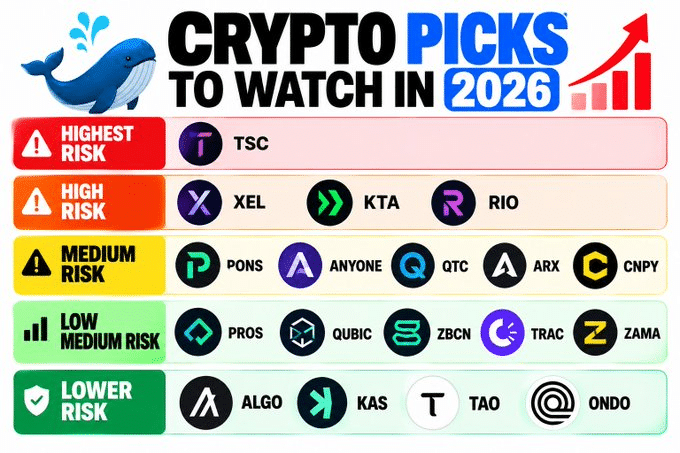
That distinction makes TSC the list’s most heavily flagged asset. However, the image supplies no volatility figures or liquidity measurements. Its ranking therefore reflects Whale Factor’s stated assessment.
The three high-risk tokens occupy the next tier. XEL, KTA and RIO share that classification, but their inclusion does not establish identical exposure. Each project operates under its own market and technical conditions.
These categories are listed here as a watchlist for 2026. Does not offer price targets, performance projections or entry points. Readers therefore have a classification, rather than a detailed assessment of each token.
Five Tokens Occupy the Middle Tiers
PONS, ANYONE, QTC, ARX and CNPY form the medium-risk group. With five entries, this is the largest single category. The graphic does not reveal the basis on which they were placed there.
The low-medium tier contains PROS, QUBIC, ZBCN, TRAC and ZAMA. These five assets sit between the middle and lower-risk groups. Their position indicates a different assessment within the publisher’s ranking.
Across both categories, ten tokens occupy the middle three tiers. This accounts for most of the watchlist’s 18 entries. Yet the graphic gives no individual explanation for any placement.
The colour scheme facilitates easy identification of the divisions. Yellow indicates medium risk, green with a lighter color indicates low-medium risk. This is contrasted with two categories above it, orange and red.
Lower-Risk Labels Do Not Remove Exposure
ALGO, KAS, TAO and ONDO occupy the lowest tier shown. This group is labeled as lower risk in the graphic, not risk free. That wording matters when comparing assets with different uses.
The four projects also represent separate areas of the crypto market. ALGO is associated with the Algorand network, while KAS belongs to Kaspa. TAO is linked to Bittensor, and ONDO operates in tokenised real-world assets.
Those differences render a single risk scale unhelpful. Projects are impacted differently by network security, adoption, liquidity and competition. Other regulatory conditions and token supply can also affect their exposure.
The selection is presented as the post, “Whale Watch”. But it does not provide any wallet data, transaction records or exchange-flow numbers. The graphic, therefore, does not show that large holders are accumulating these assets.
A closer look would require more information than the colour-coded categories. The volume and liquidity of trading may be used as an indicator of market depth. Holder concentration and token unlock schedules would provide further details. Development records, network use and security history would also help distinguish the projects.
For now, the ranking offers a compact view of Whale Factor’s selections. TSC receives the highest-risk label, while four tokens occupy the lower tier. The remaining fourteen assets sit across three intermediate categories. The labels are not self-assessed risk ratings, but the publisher’s labels without a published scoring system.