
- Bitcoin’s strong rise over the past two years is slowing down as it hovers near $108,000 inside a tightening pattern.
- Analyst Captain Faibik warns Bitcoin could drop to around $55,000 if it falls below its main support level soon.
- Bitcoin’s momentum is fading, and traders may see big price swings ahead if the current trendline fails to hold.
Bitcoin’s strong two-year uptrend could be nearing a critical point as market momentum begins to weaken. According to analyst Captain Faibik, Bitcoin’s structure is fading in strength despite holding above key technical levels. He noted on X, “I’m turning Bearish on $BTC for the midterm. However, whenever I see a short-term bullish setup, I’ll continue to share timely updates.” Faibik explained that the Bitcoin bull run is over, adding that “late buyers are likely to get trapped.”
At the time of the chart, the cryptocurrency traded at around $108,000. This long-term pattern has guided Bitcoin’s consistent climb, producing higher highs and higher lows through 2023 and 2024. Moreover, every retracement found support above the previous low, confirming steady buying pressure. However, the wedge’s structure is tightening as price action compresses near its upper boundary.
Momentum Shows Signs of Fatigue
Besides maintaining its position above the Weekly MA50, Bitcoin’s bullish momentum appears to be fading. The convergence of the wedge’s support and resistance levels indicates a slowdown in upward movement. Faibik emphasized that once this line breaks, volatility could rise sharply.
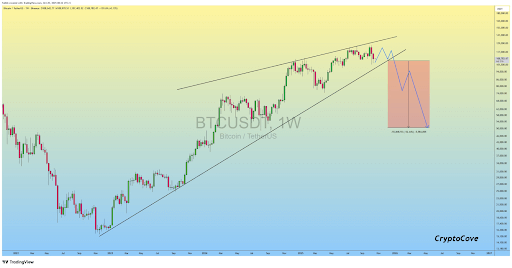
Additionally, the chart shared by Faibik outlines a possible 52% correction, projecting a decline toward the $55,000 zone. This scenario features short rebounds followed by lower highs, forming a descending pattern. Hence, if the price closes below the rising trendline, Bitcoin could begin a prolonged retracement phase extending into 2026.
In 2023 and 2024, Bitcoin continued on its upward trend. Several weekly candles ended the day close to resistance. The asset, however, had reached the wedge’s peak region by the middle of 2025, leaving little opportunity for more upward growth. Furthermore, the last line of defense against further losses is currently the long-term trendline.